
A 50 year mortgage promises affordability, but won’t deliver what it promises, and will make costs higher for everyone.
Some people are not worth listening to. They post late at night on social media, saying things that most people would be embarrassed to say and would want to delete the next morning. They are fully confident in their own ideas, even if they have no merit at all.
These people should be ignored.
Unfortunately, one of these people is our current president. So as much as I’d like us to ignore him, we can’t really. A boomer with the nuclear codes and the temperament of a toddler is someone you have to keep your eye on.
So when he creates a social media post with his face next to Franklin Roosevelt, who helped to usher in the 30 year mortgage, with the title “50 year mortgage” I and every other financial professional look up, squint, and think about it.
And in this case, most appear to be shaking their head. Me too.
But not for the reasons most have talked about.
So, is a 50 year mortgage a good idea to get more people into homeownership?
And to take this idea further, if 50 years is a good idea, wouldn’t a 100 year mortgage be better? Has anyone tried that?
You’d be surprised.
Table of Contents
The mortgage story so far
Homeownership is becoming increasingly unaffordable for Americans.
The reason for this are varied, but the mainly come down to a lack of sufficient supply (made worse by the slowdown in home construction coming out of the Great Recession) and the post-pandemic rise in interest rates, which made borrowing on already-expensive properties even more expensive.
There’s historic financial advice saying that you shouldn’t spend more than 30% of your net monthly income on your home payment. If that were to hold true, then most families would be totally out of luck. According to Investopedia, households need an annual income of $118,530 to afford the average house, which is over 50% of the U.S. median income.
So people are spending way more than 30% of their net monthly income on a mortgage, if they can get a loan at all.
30 year mortgages are the norm (here)
This is assuming a 30 year, fixed-rate mortgage, which is generally the standard in the U.S.
We are an outlier though. As I’ve wrote about before, most countries don’t offer 30 year fixed-rate mortgages, especially with the ability to refinance. If you’re in the UK, for example, your interest rate changes every five years.
The 30 year mortgage is a heads-I-win-tails-you-lose proposition in the homeowner’s favor. They lock in low interest rates when rates rise, and when rates fall, they can refinance to a lower rate.
What that means is that people who are on the homeownership train, are staying there, not moving, not trading in, making it even tougher for people not on the train to jump aboard.
What can we control?
There are some aspects of homeownership that are in our control. We could decide to own a condo instead of a house. We could opt for a smaller place, or one farther away from the city center.
On the other hand, we can’t control the price of homes though. And we can’t control mortgage interest rates, which are more or less set by the market.
But what if we could control the amount that people paid each month? If we just stretched out the terms of the loan, then people could pay less, right? Seems straightforward?
That’s the impetus behind the longer mortgage terms. The “extended release” mortgage pill, if you will.
What happens with a 50 year mortgage
A longer mortgage, for the same amount of money and the same rate, will mean that monthly payments are lower.
Let’s use a simple example: a $400,000, 6% fixed rate mortgage. (And let’s not talk about insurance or anything like that, just principal and interest.)
In a 30 year mortgage, the monthly payment will be $2,398.
In a 50 year mortgage, the monthly payment will be $2,105, which is $300 less.
(Source for my calculations here.)
So, in moving to a 50 year mortgage, the borrower can save $300 a month in this case. With higher mortgages, you can save even more.
The standard case against a 50 year mortgage
Now, the reason why most people give against a 50 year mortgage (and the argument I gave when I last wrote about something like this) is that the extra interest paid over the long term will end up, to use a polite term, screwing you over.
Here’s what I mean. In our 30 year mortgage example, the total amount that you’ll pay over the 30 years, assuming no early repayment, is around $863,000. So you’ll pay more than double over the cost of the mortgage (116% more, in fact).
But in a 50 year mortgage, the total amount you’d pay in this situation is $1.26 million. That’s $400,000 above and beyond what you’d pay in the 30 year mortgage!
The better case against a 50 year mortgage
While I think the above is compelling enough to throw the idea out entirely, many people don’t/can’t think about numbers that high over time periods that long. It doesn’t feel real. And what does feel real is that $300 extra dollars each month.
But the better case against a 50 year mortgage isn’t that you’ll pay more overall, it’s that you won’t actually save money each month either.
Mortgages of different terms have different rates. This is because lenders price differing levels of risk in to the mortgage products.
A 15 year mortgage is always going to have a lower rate than an equivalent 30 year mortgage, because a 30 year mortgage has a greater chance, statistically speaking, of going into default. The reason for this is that it takes longer for homeowners to build any level of equity in the home. The first few years of a 30 year mortgage are mostly interest payments, which is not true of a 15 year mortgage.
Also, with 50 years to pay it off, let’s face it, there are serious actuarial considerations. Not to put too fine a point on it, but the lender is more likely to die.
All of this is exacerbated on a 50 year mortgage. It’s going to take you almost 20 years to pay off even 10% of the balance of the loan.
So in all likelihood, the rates on a 50 year mortgage will be higher than an equivalent 30 year mortgage.
You won’t save money on a 50 year mortgage
I think it’s not crazy to assume that a 50 year mortgage will be 1% higher than a 30 year mortgage.
With that in mind, the monthly payment on a $400,000, 7% fixed rate, 50 year mortgage is going to be: $2,406.
That is the same monthly payment as the 30 year mortgage.
(Credit here goes to Patrick Boyle, who pointed out the interest rate differential.)
Why not 100 year mortgages?
Getting more people into homeownership through financial shenanigans will do nothing to fix the actual issue, which is that home prices, relative to incomes, are too high.
And in fact, this could make things worse.
Japan’s property bubble in the 1980’s shows a cautionary example. With prices skyrocketing, younger people weren’t able to afford any level of homeownership in the major cities. (Sound familiar?) So banks created multi-generational, 100 year mortgages. The idea was that grandkids would be paying off their grandparents mortgages and everyone could own property, eventually. (And this was seen as a good thing!)
But all this did was continue to inflate property prices. And when the property bubble finally burst, people were massively underwater on their homes, owing much more than their home was worth. It got ugly, and took a long time to unravel.
So we definitely don’t want to trend toward longer terms.
This isn’t going to happen
Luckily, 50 year mortgages aren’t going to happen.
Laws, like the Dodd-Frank Act, would need to be rewritten to allow for loans greater than 30 years, in order to be protected by federal law. And those protections are the only reasons why lenders bother with loans as long as 30 years in the first place, since they are so weighted in the borrower’s favor.
And while our government may not care about following the law, lenders aren’t as likely to openly flout the rules that protect their money.
So, in the end, we end up back where we started, with the rantings of a someone up too late on social media, too confident that they know what they’re talking about, when in reality, we know that they know nothing at all.
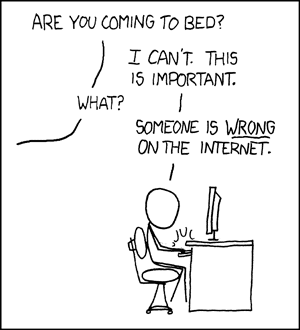
Let’s not all stay up too late to correct these people. In the classic words of XKCD: