

With the ending to penny production, the habit of merchants rounding cash purchases have some wondering if they lose out.
Well, it’s official. With the signing of the Common Cents Act on November 20, 2026, the U.S. government has ceased minting pennies for circulation. They can still mint pennies for special occasions, and all the pennies that are still out there remain legal tender.
When the history books are written about this current administration, they will primarily be remembered for the rampant corruption, unconstitutional acts, inhumane treatment of everyone from immigrants to citizens, the deaths of hundred of thousands of people due to aid cuts, and so much else.
It’s hard to find anything good to have come from the last few years. But if I had to think of something—anything—to put in the positive column, I’d have to point to the elimination of the penny.
It’s not that I hated the penny, it’s just that everyone realized that there wasn’t any point to it anymore. It’s not just because most transactions don’t happen in cash anymore (though that’s true), it’s just that in the days of $20 burritos, a penny just isn’t worth anything in a practical sense.
We’ve known for years that it costs multiple cents to produce a penny, so we’ve known that minting them is an incoherent process.
Well, that’s all in the past now.
A vocal minority have asked how to handle cash transactions with a decimal amount ending in 2 or 7 or 9. Won’t businesses just use it an excuse to charge us more?
The short answer is “no”. The longer answer is still “no”.
But if you want a proof—and I mean a mathematical proof—of the “no”, keep reading.
How to round a transaction
We aren’t the first country to eliminate the penny from circulation. Canada, the UK, Australia, and quite a few others, did it first. So we have plenty of experience to pull from.
The general guidance on penny rounding has been around for a while now. It states:
- If the amount ends in 1, 2, 6, or 7: round the price down
- If the amount ends in 3, 4, 8, or 9: round the price up
- If the amount ends in 0 or 5: do nothing
So if you buy something and it costs $3.12, you pay $3.10. If you buy something and it’s $19.99, you pay $20.00. And if something is $5, you pay $5.
This covers every possible contingency. And if you can read math word problems (which I grant that many can’t), you can see that this will result in a net-zero change in prices over a sufficient number of transactions, assuming random price outcomes.
Testing price neutrality (with Python)
Sounds great in theory, but I wanted to test this out.
So, I wrote a Python script to simulate a number of transactions.
(No, I didn’t use AI; I wrote this script myself. Yes, it would have been faster to use AI, but it’s too important to me to not outsource all of my thinking to AI.)
I first assumed even distribution of prices, meaning, that there was an equal chance of a price being ending in a 2 as a 6 or a 9 or any other number.
Then I created a tally. When a price ended in 1, that saves you a cent (because you’ll end up paying less), and so I added a cent to a tally. But when a price ended in 9, that costs you a cent (because you’ll end up paying more) so I subtracted a cent to the tally. And all the rest according to the above rules.
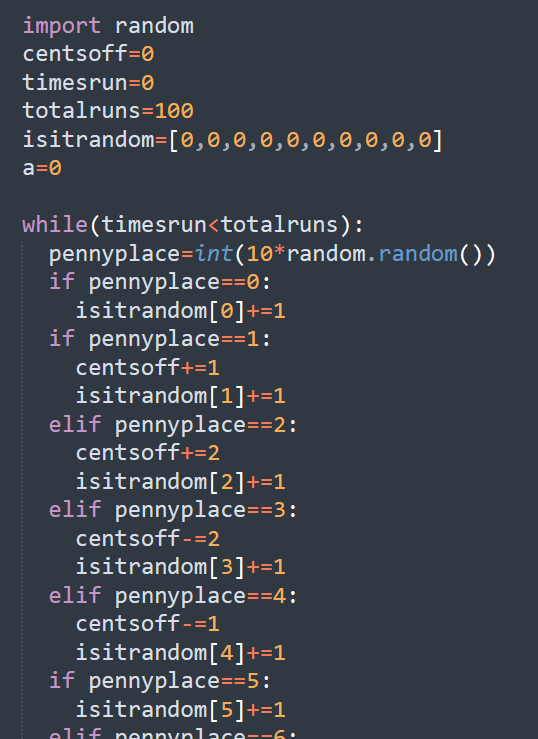
Running the script
I then ran the script to simulate 100 transactions. The script said that after all 100 transactions, I was out 4 cents.
I then ran it again, and it said that I was up 18 cents.
Not exactly neutral, but pretty close.
So then I upped the ante and simulated 10,000 transactions. It said I was up $2.06. Then I kept it going, and simulated 1,000,000 transactions. It said I was out $20.61.
Now that may sound like a lot, but it represents an average of $0.00002 per transaction.
Why not zero?
You may ask why we were up or down anything. Wasn’t rounding supposed to be a neutral price change?
Yes, but the answer lies in statistics. A coin flip has exactly a 50% chance of landing on heads, but if you flip a coin 100 times, it’s unlikely that you’ll get exactly 50 heads.
Same thing here. As the number of transactions approaches infinity, yes, the net change would be zero, just like the number of heads would be 50%. But we’re not running an infinite number of transactions.
(For fun, I ran the script 1 billion times, and found—this is true—that I was up $12.29.)
The numbers we’re talking about are very, very small.
What about all prices that end in 9?
(From Clerks, in case you didn’t know.)
I initially assumed that prices are equally likely to end in any digit, but that’s not true. As we all know, prices tend to disproportionately end in 9. $0.99, $19.99, etc.
So I went in and tweaked the script to account for it. In my random number generator, instead of 10 values, I picked 11, and made two of them 9. Thus, instead of a 10% chance of any number, there was a 9% chance of 0-8, and an 18% chance of a 9.
I then ran the script again, simulating 1,000 transactions.
This time, it said that I was out $1.54.
Not that neutral. But that tracks, right? In this scenario, there is a greater chance for there to be transactions that cost a cent or two than there are ones that give you a cent or two back.
And sure, I could (and did) run this script with a million transactions, and I could be out maybe $100. But I ask you: how long would it take for you to have one million transactions…in cash?
This is not an issue
Ultimately, I think we can consider the experiment a success. It validated that in most cases of penny rounding, people are not likely to be penalized any serious amount of money, if any money at all, and in fact people may be up a small amount of money over time as well.
And again, this is not an issue, because fewer and fewer people do transactions in cash. And as I’ve explained before, over time, fewer transactions are going to even have a cents component.
Given inflation, the day can’t be too far off when all prices will be rounded to the nearest dollar. But even when that happens, the math will be exactly the same, and we won’t lose anything, except maybe some loose change.


Leave a Reply