I’ve spent the last year with peak/off-peak energy pricing on my electric bill. I dig into the data to see whether it can save you money.
One year ago, I signed up for the “Time of Use” plan with Pacific Power, my electricity provider. “Time of Use” is a peak/off-peak pricing scheme that encourages off-peak usage by lowering rates on off-peak usage while raising rates on peak usage. The idea is that if you shift your usage to off-peak, you’ll save money.
And who doesn’t want to save money on their electric bill?
This was especially true for me as I don’t have gas in my place, so all heating/cooking/etc. is done with electric.
So I signed up, and as I wrote before, I got a promising first month savings difference. Not much, but not nothing.
I’ve now been through an entire year of peak/off-peak pricing. And I’ve dug into the data to see whether I saved any money at all.
Let’s see the numbers.
Table of Contents
Details first
The way “Time of Use” works at Pacific Power is that it takes the standard residential rate and subtracts or adds the off-peak/peak pricing.
Peak hours are defined by Pacific Power as 5-9 PM every day.

They publish the full rate list here. The standard electricity rate in Oregon is 14.204 cents/kWh, with following modifiers:
Off-peak: 14.204 – 3.790 = 10.414 ¢/kWh
On-peak: 14.204 + 14.270 = 28.474 ¢/kWh
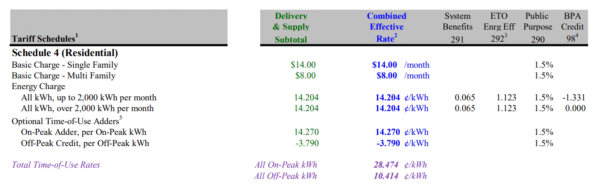
So using energy at peak times is almost three times as expensive as off-peak times. That’s a real incentive to divert your energy usage.
Time-shifting electricity
What are the most energy-intensive tasks in my home?
- Washer/dryer
- Dishwasher
- Shower
- Stove
- Heat
My goal was to minimize the use of the above during peak hours. This was sometimes easier said than done.
Easy: Washer/dryer and dishwasher, because I could just run these at other times in the day. Shower was mostly easy too, as I shower in the morning.
Challenging: Stove, because that’s prime dinner time right there, and so I’m either making a cold dinner, eating early/late, or spending a lot of money on electricity.
Really hard: Heat. I live in the Pacific Northwest, so most of the year requires heating. What am I going to do, set the heat really high right before peak time and then let it ride for the peak hours? (Okay, that’s what I did, but it was for science!)
My change in electricity rate
Here are the results.
First, the electricity rate. On the left is what rate I had before I turned on peak/off-peak usage, and the right is the rate I had afterward. (And keep in mind that these rates factor in taxes and fees, and so will be a little higher than the official published rate above.)
Why did I use the previous year? It was the best control group I had. My usage wouldn’t be exactly the same, but it would be close, and would account for seasonal differences, which is where a lot of the variation comes in. If I had tried to guess what my standard electric rates would have been over the same period, it would have just been a guess.
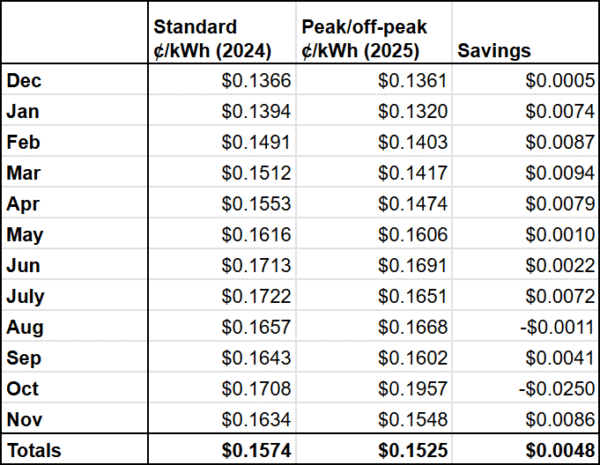
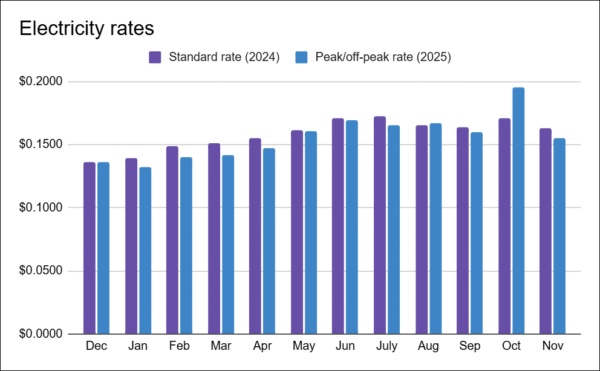
So, as you can see, I saved about half a cent per kWh over the course of the year when compared to the previous year.
That’s not a lot, but it’s not nothing.
What I found was that my rate was lower using peak/off-peak pricing over the cold months. This is because heat is my most-used appliance, so the differential in kWh between peak and off-peak is at its highest. I don’t use much electricity in the summer, so in those months, the difference was slight to nonexistent, and in some cases, the rate was higher with peak/off-peak usage.
And as for that spike in October? I was gone for half the month on a trip to Japan, and used basically no energy at all. So all my appliances were minimally run, but not timed for peak hours. So the rate was higher, but my actual electric bill was really low that month.
Which leads me to the bigger question: how much did I save?
My change in electric bill
This is where it really matters. Did I save money?
Here’s the table and the resulting chart:
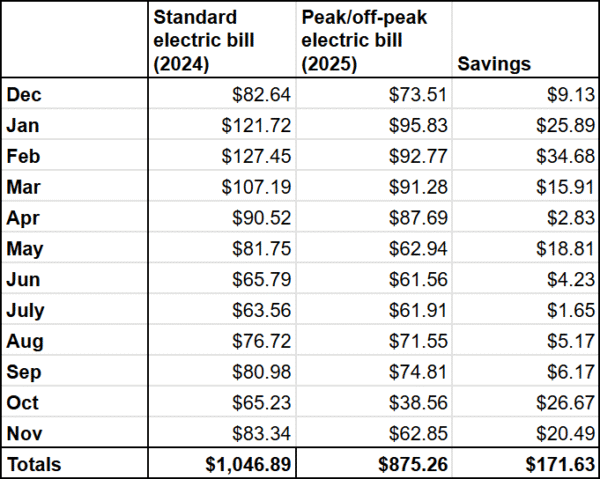
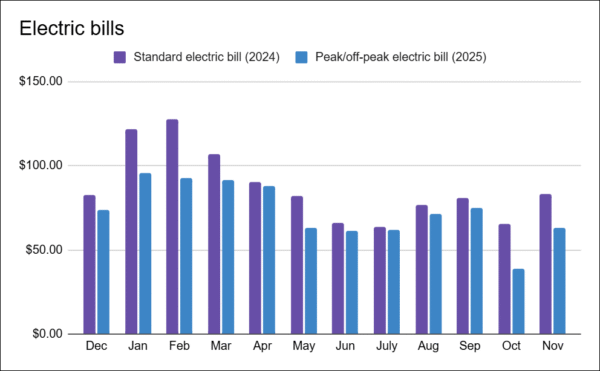
I saved $171.63 on my electric bill compared to last year. That’s a 16% reduction.
So, the resounding answer is, yes, I saved money due to peak/off-peak electricity pricing.
Wait, the math doesn’t add up
If you’re paying attention, you’ll notice something was off with the numbers.
I saved a half cent per kWh throughout the year, around 3% of my rate. And yet, I had a 16% savings in my bill. What gives?
This is where psychology and behavior comes into play. While my rate wasn’t that much lower, my usage declined. I believe this was because I was more focused on watching the clock, and delaying certain appliance usage until after peak time. This moderation and focus, not to mention greater awareness, led me to use less energy.
Hmm, where have I heard that before? Sounds like what I suggest around tracking your spending, doesn’t it?
Should you switch to peak/off-peak pricing?
So we’ve seen, with a sample size of one, that it is possible to save money on energy usage by switching to a peak/off-peak electricity plan.
So should you do it? I’m actually not so sure.
If you’re willing and able to keep a firm eye on the clock and minimize usage of power-hungry appliances during peaks time, you can save money.
But you have to keep on it. You can’t casually dip in and out of keeping track of the time. Remember that, at least in my case, the penalty for usage an appliance in the peak hours was an electricity cost that’s almost three times as high!
So everyone in your house needs to be firmly on board. So if you have kids, and/or the people you live with aren’t totally into this idea, it’s probably not going to work, and you might end up with a higher electric bill. It’s certainly not for everyone.
But as for me, I loved the challenge. I loved saving money, and I really liked that my electric bill never went above $100 last winter. But I also really enjoyed gaming the system for my own benefit. For me, it didn’t take too much sacrifice. I thought it was worth it, and I’ll continue switching my usage to off-peak hours as much as possible.
And also, using off-peak energy is better for the environment and for the power grid too, so you’re helping your community. That’s a nice bonus.