
The price of gold hit $5,000 an ounce recently, a remarkable rise in price. Was it foolish to sit this rally out?
I recently watched a Dave Ramsey video from 2023, where a caller asks whether he should put some of his excess investment money into no. “No!” Dave Ramsey says, reflexively. “The average annual rate of return on gold sucks,” he adds.
More interesting was the comment section. “This aged like a glass of milk,” said one commenter. “I’m sure the caller is very thankful now to miss a 50% rise in gold prices,” adds another.
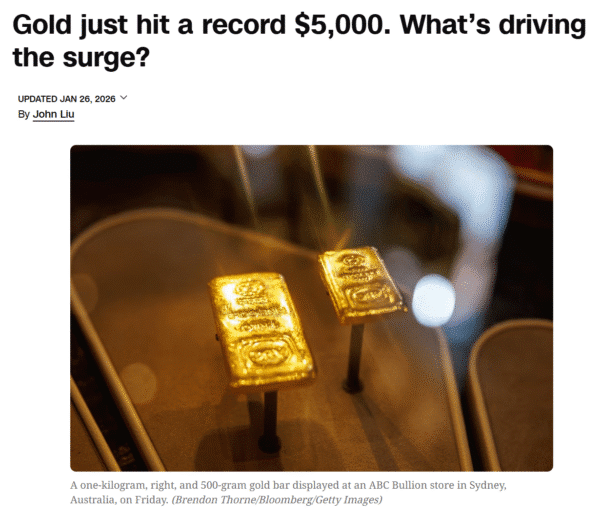
That’s because gold was, at the time the video was published, worth around $1,900/oz. The headlines have recently show that the price crossed $5,000/oz.
I’ve long been critical of the “gold rush”, the push to invest in gold as a “safe haven” against economic calamity. At the time of writing, I personally own no gold, physical or otherwise, that I am aware of.
But with gold at all-time highs, the questions become uncomfortable: Did I miss the boom? Is it too late to get on board? Should you even get on board? What’s going on here?
Let’s take a look.
Table of Contents
Why the gold price is rising
Gold is a precious metal that has traditionally been seen as a “hedge against inflation”. It’s an insurance policy, typically a fear index, and often, though not exclusively for those on the right.
(I remember people on the right saying that Obama’s economic policies would lead to economic devastation, and that everyone should buy gold to save their money from ruin. Today, it seems like those on the right are saying to buy gold now too, though perhaps the irony is lost on them.)
Geopolitical instability is also a factor, combined with concerns over the Federal Reserve and it’s ongoing governance/independence, or lack thereof.
Another factor: Central bank shopping spree
But there are other factors at play here. Central banks have been buying gold at a massive rate recently, over 1,000 tons in each of the last three years.
Why the feeding frenzy? The sense I get is that it’s partially about a flee from the dollar as a reserve currency, and partially a flee from the debasement of the dollar. The dollar has, after, lost a fair amount of value recently, and some say that it’s slated to fall further.
Now, this flee from the dollar doesn’t signify that the dollar won’t continue to be the world’s reserve currency for the foreseeable future. If it does, then all bets are off, but their is no agreed-upon successor to the dollar. Not the renminbi, not the Euro, and not even gold. (And certainly not Bitcoin.)
So the price of gold is much more about central bank moves, and much less about retail investors buying as a hedge against inflation.
Whether they continue to do this remains to be seen.
What you missed out on
So gold prices went from $1,900 in May of 2023 to $5,000 this past month. That’s a rise of around 44% compound annual growth.
Compare that to the S&P 500, which went from 4,200 to 6,900 over the same period, a rise of around 20%.
So yeah, you could have made lots of money if you’d put money into gold.
Is this time different?
The thing is though, if you zoom out to pretty much any longer time span, you would have made much more money over the long term in the broader stock market than if you had bought gold.
So the question becomes: is this massive price appreciation a short-term change or a long-term signal?
And that is a question that no one truly knows.
If you believe that the U.S. is in a slow death spiral of debasement, then yeah, gold does seem attractive as a way to preserve your money.
But as I never grow tired of saying, if our money becomes worthless, we’re going to have much bigger problems. And getting value out of your gold purchases is going to not be at the top of your list.
Remember, if you buy gold on paper, then you need to rely of the system functioning properly to get your money out. And if you buy physical gold, well, what good is that going to do you in a financial collapse?
What about just making more money?
But even if you’re not worried about financial collapse and just want to know if this is, say, a better investment than mutual funds, I would say that you have to look at the largest possible timeline you can.
And that timeline doesn’t show gold as a good investment for long-term appreciation. Short-term, yes, but not long term.
Sure, if you put a lot of money in gold in May 2023, and sold it today, you’d have made a decent return. But we could play that game with any cherry-picked dates and assets. Gold isn’t unique in that regard; it’s just had a nice run recently.
It’s (probably) too late
Do you want to be chasing trends? I don’t think you do. By definition, if you chase a trend, you’re already behind.
And gold has been very much in the media recently, especially since it’s rise above $5,000. To me, that’s the sign that the boom times have ended. The people who really benefit got in before everyone started talking about it.
Generally speaking, if the media is talking about any particular investments as part of the news cycle, it’s probably too late.
Think I’m wrong? Well, between when I started writing this article and when I finished it, these two articles were posted.
First:
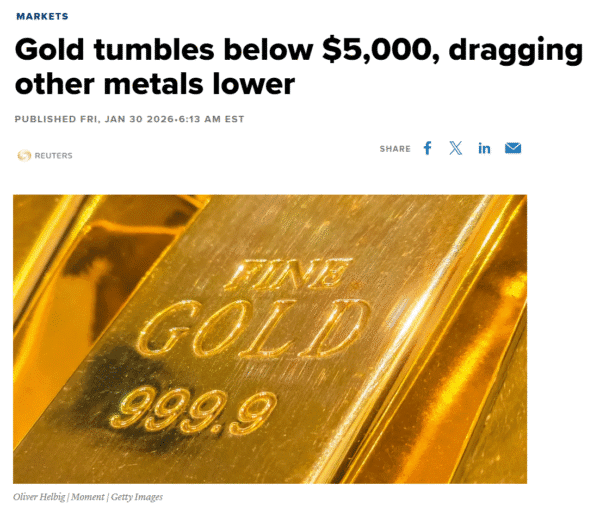
Then, the next day, gold prices slid almost 10% in one day, the biggest daily drop since 1983.
So is it too late for you to benefit from the gold rush? Signs at the moment are pointing to yes.
But really, this was never a long-term strategy anyway. There are always ways to make short-term profits, but we call that luck.
And I don’t want you to base your financial future on luck. I’d prefer to stick to investing in low-cost broad-based index funds, and the slow and steady accumulation of money. It won’t make headlines, but it just might make you wealthy.
Reminder: Nothing on this site should be considered financial advice.