
Inflation affects your savings more than you might think, which is why you need to be mindful of your rate of return.
Before we get started, I want you to look at your savings account(s), if you have them. Specifically, I want you to look at the interest rate that your savings accounts are earning.
If the interest rate on your savings accounts is any amount less than 3%, I want you to go to this site, pick a savings account provider, and open a new account there. And then, I want you to move your savings over.
There isn’t any real justification for parking your money in a savings account earning 0.04% (the going rate at Bank of America, at the time of writing,for example) when you could be earning more.
And these days, 3% is actually not even enough. Here’s why.

The purpose of savings
What’s the point of maintaining a savings? The way I see it, savings has a couple of different purposes:
- Saving up for a one-time purchase
- Saving up for ongoing purchases
- An emergency fund for the unexpected
You can probably think of other reasons, but these are the big ones.
Zooming out even further, what you are doing with savings is that you are time-shifting your money. You put it away now, so that you can use it later.
And it’s the time aspect that’s important here.
Time devalues money
Our capitalist system of finance requires that money becomes devalued over time. This is another way of saying that we have “inflation” built in to our economy.
Why? I don’t know, I’m not an economist. I read this Investopedia article, but to be honest, I’m not sure it satisfactorily explained it. I then read this Reddit post, and while I have no idea if it’s correct, it at least provided me with an easy sound bite.
The reason we have inflation is because deflation is really, really bad. So we’ve decided to err on the side of having a little bit of inflation rather than risking deflation.
I don’t know if that’s a compelling argument, but the practical reality is, we have to deal with inflation in our economy.
And that means that the value of our money—our purchasing power, if you will—will slowly erode over time, unless we do something about it.
Inflation is inflating
The Federal Reserve, the agency responsible for managing these things, has set a long term target of 2% inflation per year. So if we have an average of 2% inflation over the longer term, we’re doing quite well.
And, well, that’s not exactly what’s happening.
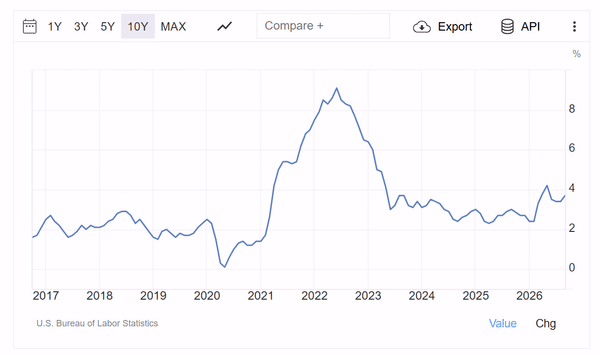
The pandemic obviously messed everything up, but since then, inflation has been stubbornly higher than 2%. The most recent data shows inflation running at 3.7% in fact.
What does that mean? Well, to oversimplify, your money is worth 3.7% less than it was last year. And if trends continue, it will be worth that much less next year.
Your savings must keep up
So if you have $1,000 saved, and inflation is running at 3%, then next year, you will have to have $1,030 next year in order to be able to do as much with that money as you could this year with you $1,000.
If you just keep your money under the mattress, its value will slowly erode. You need to earn interest on your savings to be able to keep your money from devaluing.
And that’s why you need to be earning at least 3% on your savings; you need to be able to at least keep up with inflation. If you don’t get to that baseline, your money will lose value, and it’s as if you were losing money, even by doing nothing.
Try to outpace inflation
Now, just keeping your money in line with inflation is the very barest of goals. It would be great to be able to earn more than that, wouldn’t it? To make your money actually grow, even when accounting for inflation?
Well, that’s possible, but there’s a limit. Savings accounts and the like tend to not offer much beyond inflation. If you need a larger rate of return, you typically will have to invest your money into products like mutual funds and like. You can certainly earn a hefty return that way.
But unfortunately, then it’s no longer liquid, meaning that you should be able to access it without penalties. If you have to pay capital gains tax to access your savings, that doesn’t seem like it’s the right place for your money, especially when you’re talking about what is potentially an emergency fund.
Make your money not shrink
I think savings should be liquid, and accessible without penalty.
Beyond that, I think you should not have to pay for the privilege of having savings. That means that at the very least, your money shouldn’t shrink because you are sitting on it.
That’s why you have to counter inflation in your savings. And these days, that seems to be at least 3%, maybe more. So you want to put your money in an appropriate place to make that happen.
The last thing you want is to let your hard-earned savings leak away over time.


Leave a Reply