A mortgage with no money down for a down payment sounds like a great deal. But is it as good as it sounds?
I just got an email from my credit union with the heading: “Buy your first home with $0 down”
Now, I like my credit union, and I think in general they mean well. They are certainly nothing like Wells Fargo or the other big banks.
But it got me to thinking: is it even a good idea to get in on a no money down mortgage?
Read on to learn more.
Housing is expensive
No reasonable person will disagree that housing is much more expensive today than it used to be, relative to incomes.
And then there’s the down payment issue. You generally need to put some money down as a down payment. The preferred amount is 20%, but you can generally find mortgages where 5-10% is all you need.
Still, that’s a big chunk of change. On a $500,000 home, 10% is $50,000. It’s not exactly easy to put that much money away, and that’s before you factor in the costs of home upkeep.
And if you put down less than 20%, you generally have to pay mortgage insurance, an extra monthly fee that’s basically insurance you pay on the bank’s behalf. (I paid this for a few years, and getting rid of it was a saga in itself.)
So, it’s natural to want to find a workaround.
Mortgage rates are high these days
Also, the current rate on a 30 year, fixed rate mortgage is around 6.7%. That’s high when compared to the pandemic days, but low compared to the 1980’s, when rates were upwards of 20%.
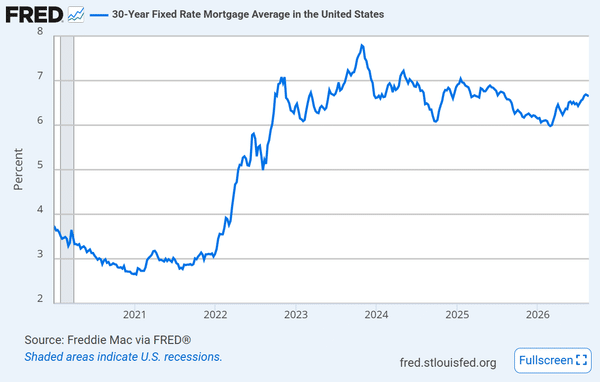
But most of us don’t remember the 1980’s; we remember when you could get a mortgage for under 3% a few years ago. That you can’t now, hurts.
And the reason why it hurts is that the higher the interest rate, the more expensive the home costs. A single percentage of interest rate rise can increase your monthly payment by a few hundred dollars. When housing is already expensive—with down payments to match—that puts more homes out of reach for people.
So anything that can help keep your costs down is a good thing, right?
The $0 down mortgage
I remember the financial crisis of 2007-2008, and while a lot of it was created by morally-bankrupt financiers creating garbage financial instruments and then trading them around, a lot of the pain was felt by people who bought homes they couldn’t afford. These “subprime” buyers/mortgages were helped into their homes by creative accounting that didn’t take into account risk (or reality).
It became easy to buy an expensive home for little/no money down, but for many, this led to them being in homes they couldn’t afford. Faced with foreclosure, many walked away and lost everything.
So when I see the idea of a $0 down mortgage now, I’m suspicious.
The $0 down mortgage details
But my credit union is not a predatory bank, so if there’s going to be a good deal for customers, this is probably going to be as good as it gets.
So let’s dig into the details:
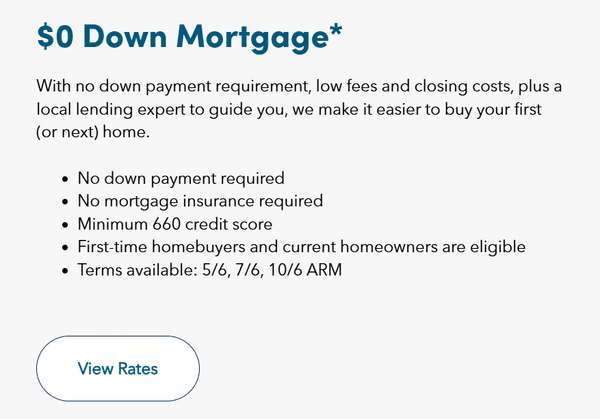
The first two bullet points look good. No down payment, and even no mortgage insurance! That was pleasantly surprising.
The minimum 660 credit score isn’t terrible either. While I argue that most of the time people worry way too much about their credit score, if you’re in the market for a mortgage, it’s not a bad thing to keep an eye on it.
I also love that this isn’t just available to first-time homeowners. Why, I could get on board here!
It’s just that last bullet where everything comes crashing to the ground: These mortgages are adjustable rate mortgages.
What is an ARM?
An adjustable rate mortgage (ARM) is, as the name suggests, a mortgage whose rate fluctuates over time. So, unlike a fixed-rate mortgage, your rate (and thus your monthly payment) may change.
A 5/6 ARM means that the rate will stay the same for the first 5 years, and then adjust every six months. A 7/6 ARM and 10/6 ARM will stay the same for 7 and 10 years, respectively.
The adjustable part is based on market conditions, just like the fixed rate is. To simplify, you can assume that if one is going to go up, the other will too.
ARM wrestling
Getting a mortgage with an adjustable rate is basically like playing the lottery. You’re betting that interest rates don’t fluctuate to the point that the home becomes unaffordable. (Because remember, when the rate goes up, the monthly payments go up.)
No one knows where rates are going. But do you have faith in the U.S government (and the Treasury Secretary) to manage the economy with integrity and restraint?
So, do you feel lucky? Well, do you punk?
No money, all of the risk
I think the ARM is the reason why this product is a viable offer for the bank. But let’s say that you found a fixed rate option with no money down. Is that okay?
Well, maybe. The problem is one of math.
Let’s say that you got a 30 year, fixed-rate mortgage. Let’s call it 6% to make the math easier. With zero money down, you’re not even getting to 10% equity until well over 5 years. That means that at that time, roughly 80% of your mortgage payment will be going to interest, with only 20% going to pay down your principal.
In short, it’s going to take forever to get some traction (and build equity).
Yes, you’ll be living in a home while you are paying all this interest, but it’s going to cost you. Over the long term, on a $500,000 home, after interest, you’ll be paying over $1 million!
Personally, I don’t think that’s a good deal, even with rent being as high as it is.
Rent and save up
If you’re wanting to buy a home, I totally understand. It can be a great deal for some people in some circumstances.
But wanting something doesn’t mean that you can afford it. And if you don’t have any money for a down payment, I don’t think you are ready to buy a home. It’s just too expensive and too risky.
Now, if for some reason your equivalent rent would be so much more than this theoretical home, then your situation may be different. But for most people, I’d say, rent for now and save up something, anything, as a down payment. You won’t be charged interest on that money, and you’ll start to pay down your mortgage much sooner.
And if you can’t put away that kind of money, maybe you wait until you do. I have a strong feeling that you could probably be more intentional with your money and eke more out of your paycheck each month. Let me know if you want help with that.