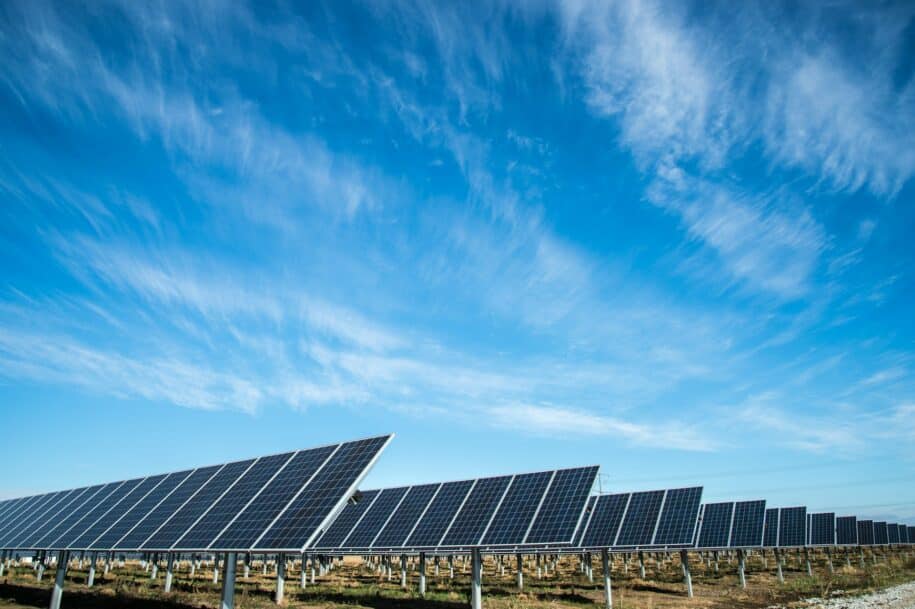
The process to sign up for community solar in order to save on my electric bill has been longer than expected, but is still going forward.
In my quest to lower my electric bill (and to help you do the same), I’ve been trying to get creative. I signed up for peak/off-peak (“time of use”) energy pricing, and succeeded in lowering my bill by about 25% my first year.
I also have been looking into solar, as solar seems like the most obvious way to reduce one’s energy prices. Not only are we experiencing greater warmth and heat pretty much everywhere, the cost of solar panels has been getting cheaper at an almost geometric rate over the past few years.
But living in a condo, I have access to my roof, but can’t put anything on it, so solar panels are out. And my backyard is both diminutive and north facing, so even if I DIY’d some solution out in the back, I’m not getting much out of it.
But then I learned about something called “community solar” and I was instantly excited. This is a setup where you “join” a solar farm, and get benefits from it, just like you would with a CSA. It connects to your existing energy account, and you get a credit based on how much energy you use.
It sounded too good to be true, but also worth looking into.
It’s now been almost two years. Here is an update on how it’s going.
Solar in Oregon
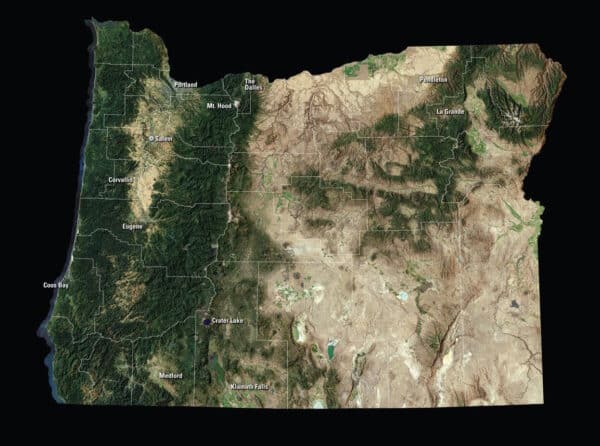
I’m fortunate to live in Oregon for many reasons, but in this case, it’s because Oregon is very progressive, large, and sunny. What, you think Oregon is a rain-soaked forest? Take a look at the map again: two thirds of the state is basically desert/tundra:
Anyway, because of this happy confluence, solar has a great foothold in Oregon, both because of geography, and because the powers that be incentivize it, seeing (rightly) that it is a win-win situation for energy producers and consumers.
Side note: It is absolutely infuriating how renewable energy like solar has been politicized. Solar benefits literally everyone, and has zero downsides. (If you don’t like that panels are made in China, you could always start making them here.) The only people who are against solar are a) paid by fossil fuel companies, or b) have a knee-jerk reaction to anything that doesn’t feel “manly” enough, like getting dirty in the coal mines.
Point being, this seemed like a perfect place to get connected to community solar.
Arcadia
After some research, I found a company called Arcadia. They got some iffy reviews online for being a bit pushy in the sales department, but they also do more things than community solar. And they have no reason to be pushy with a community solar customer, because they’re not taking any of my money from me.
Yes, that’s why community solar seems too good to be true: Because it’s free.
The only catch is that you have to sign up and be connected to a solar farm.
And when I last wrote about this project, it had been three months, and I was still on the waiting list.
Why was this? My guess was a combination of factors, but probably having something to do with the US federal government transitioning from “let’s invest in our future!” to “we’ll go down as the last petrostate!” With federal subsidies for solar changing, I’m sure the economics of solar farm production changed in some way, even on the industrial level, and even in a state like Oregon.
Checking in with customer service
Nevertheless, after a year had passed, I decided to check in with Arcadia to see if perhaps my application had fallen into a bin somewhere.
What followed was a multi-month conversation involving a lot of confusion and misunderstanding. Here’s what transpired.
The first message I got back was in October 2025. The person who wrote back said:
“I understand your concerns. Currently, the rate isn’t aligning with what we’d hoped for under the community solar norms. Please rest assured that our team is actively monitoring the situation. As soon as the delivery/supply rate improves, we will assign a suitable solar farm to you. We appreciate your patience as we work through this.”
I appreciated the response, but didn’t know what it mean. What rate? Whose rate? The rate I pay? The rate the solar farm pays?
I wrote back, and waited almost four months to get a response. The response I got back seemed to sidestep my question entirely:
“Since there is no access for our team to check your utility account and utility bills, the solar developers has to check with the utility about your usage and the rate.”
This was curious, because I had connected my account to Arcadia’s system back when I first signed up. So I logged in and reconnected it, to make sure that they could see into my account to get whatever information they needed.
This seemed to work, as I got a few emails back saying that they were working on it.
More customer service confusion
In March of this year (2026) I got a note asking for my annual usage details, as this was “missing” from my bill.
Again, this was curious, as if you have all my monthly bills, surely it’s simple math to get an annual bill, right?
Then, the customer service person asked for the impossible:
“If possible, you may also want to check with your utility provider to have it included on your bill.”
“Hello, Pacific Power? I’d like to request that you change the structure of your billing statement to serve the needs of a community solar company I’m working with. Hello? Hello?“
I told the person, more or less, to get real, but also sent over a file containing just my monthly bills for the past two years.
More time passed, and then I got the strangest reply back from Arcadia:
“The team has informed me that the Pumphrey file currently includes only gas data. Could you please add the electricity data in kWh to the Excel file and let me know once it’s updated?”
Um…
I live in a place with only electric. I don’t have gas. So, I can’t have sent over gas data because I don’t have gas data. They have a direct connection to my electric bill. Who is running the ship over there??
Success?
Two weeks later, I received a happy email:
“You are now successfully connected to the Chapman Creek Solar project, and we will keep you updated throughout the process.”
I tried to find information on Chapman Creek (I pictured going there to visit, as though meeting a pen pal) and found that it’s in Cave Junction, just north of the California border.
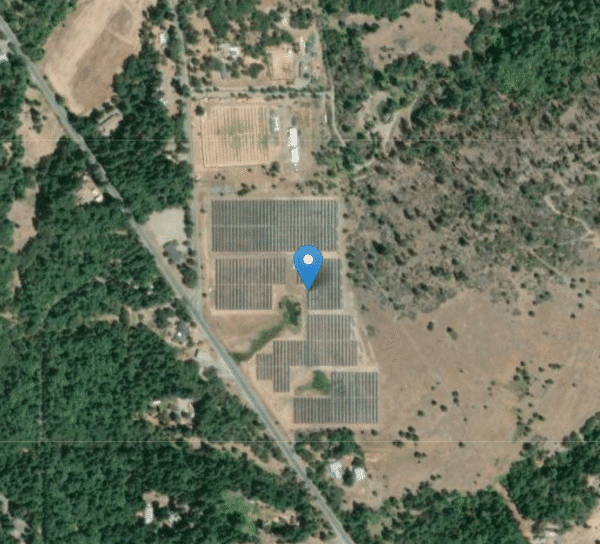
It’s new, having opened in May of 2025. That this place opened a year after I signed up for community solar makes sense, as I would imagine that demand is greater than supply right now. In fact, I think the only thing keeping demand down is that (like time-of-use), people just don’t know about it.
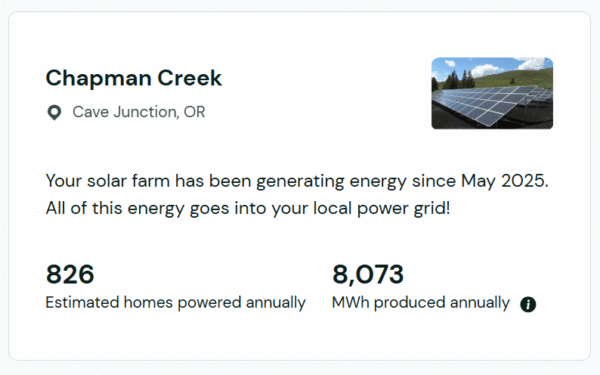
This is one of 29 (to date) solar farms in Oregon, with a current expected MWh of over 120,000. Think about just how much energy that is that wasn’t produced by oil or gas.
Still waiting
Unfortunately, the story doesn’t end there. Just being connected to a solar farm isn’t, apparently, sufficient to start the flow of energy savings. Apparently this part takes somewhere between 1-4 months to get going.
So I’m still not saving money on my electric bill through community solar. But I’m getting closer.
If there’s any moral to this story, it’s that if you want to get some savings plans in place, start now, as it will likely take longer than you think. Setting up my peak/off-peak plan took months too.
But once the plan is set up, the dividends will keep on paying out.
If you want to learn more about community solar, you can do so here, or do a search for “community solar” with your state’s name, as the rules for each state are slightly different.
And once my account starts producing solar energy, I’ll be sure to write about what my savings is.