

It does seem like everything will keep getting worse, but looking to history offers some solace and consolation.
If there’s one thing I keep hearing these days, it’s the statement that everything is just getting worse.
Prices keep going up, while quality is going down. Websites don’t seem to work anymore, and even one’s cherished phones can sometimes be slower than a PC from the 1980’s. Many people have given up on the hope of ever owning a home, or even paying off their student loans.
And then there’s our dear leadership, which in the US appears to have the generalized temperament of a toddler. We’re now in a war where there isn’t even any pretense to convey why we’re doing it, which means it comes down to some form of “because it’ll be cool”.
Will this ever end, and when?
I of course have no crystal ball, but I do have some thoughts, which might be of some comfort in these dark times.
Table of Contents
The thermostatic reset
When November 2024 happened, similarly to November 2016, I started saying a mantra, which goes more or less like this:
“It’s going to get worse before it gets better. And it is going to get worse, but it will also get better.”
That’s my core belief, and I hold to it, mainly because so much of modern life appears to be thermostatic in nature.
Thermostatic means that as aspects of life (or politics) shift too far in one direction, they will be offset by a push in the opposite direction, to course correct.
You can see this in politics. Just looking at presidents, Carter was a response to Nixon/Ford. Reagan was a response to Carter. Clinton was a response to Reagan/Bush.
And you can see this in policy as well. When the Gilded Age allowed too much power to be concentrated into the hands of the powerful and corrupt, along came Teddy Roosevelt and his “Square Deal”.
The Square Deal and New Deal
The end of the Gilded Age in the US is an interesting historical parallel to today, because it shows that there is some historical precedent to when the super-rich and powerful get some pushback a bit in favor of more progressive policies.
Roosevelt was president from 1901-1909, and fought for progressive causes including:
- Workers’ rights
- Workers’ compensation
- Income tax on the wealthy
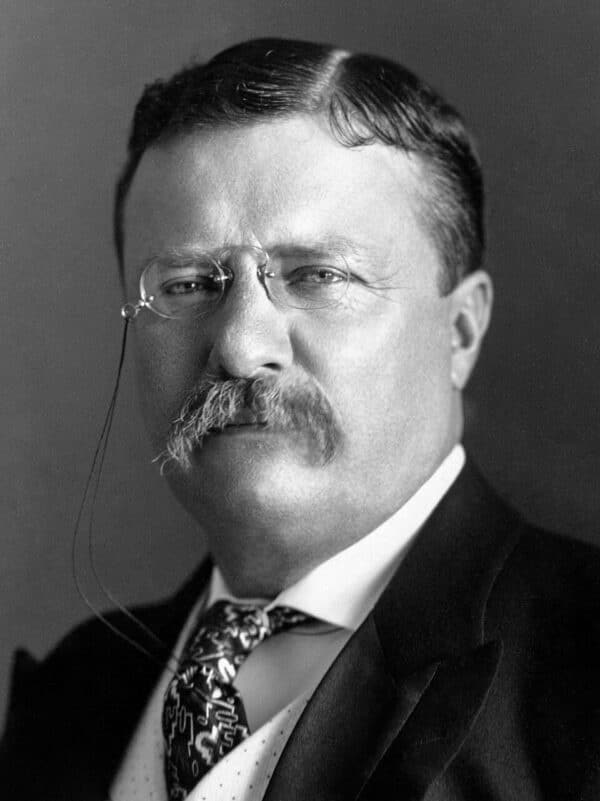
This wasn’t perfect, but it was a far cry from the ascent of the Rockefellers and Carnegies, and their ability to buy and maintain power.
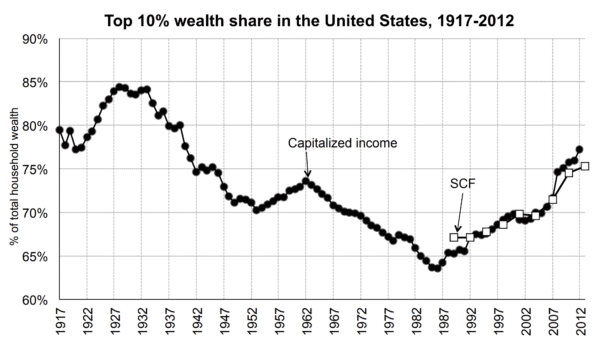
A generation later, there was also The New Deal, FDR’s signature policies, which continued down a similar realm in the response to The Great Depression. I’d argue that New Deal policies did more to reduce income inequality than anything else in the 20th century.
Just look at this chart. The middle part, not the part where it all goes wrong more recently.
We can push back
My point in bringing up all of the historical context is that, for all we say that “this time is different“, in some ways, it’s not different at all.
And in the past, people and policies were able to push back against the entrenched interests of the super wealthy to create a world where more people can thrive.
True, we’re living in a timeline where science is being defunded, education is seen as a detriment, and the cruelty is the point.
But it doesn’t take too many people in positions of power to change that focus. If, as we’ve learned, one unhinged person can do so much damage at the top, then why couldn’t a different person push forward with massive reforms to taxes, the social safety net, wages, education, and economic productivity?
If that sounds too crazy, then how about what we can do on the more local level? I live in Oregon, and while the Federal government might resemble a rogue state, Oregon has amended its Constitution to provide the right to affordable health care, and strengthened voting rights.
I’m just saying, change is possible.
The light may not be visible just yet
It’s hard to remain optimistic right now. While things seem like they are becoming harder for everyone, we have one of the most corrupt governments this country has ever known. The US rank on the Corruption Perception Index is the lowest it’s ever been since the ranking begun in 1995.
I don’t expect much of anything to get better over the next three years. They may stop getting worse, but that’s about all I’d hope for.
But if we can hold on long enough, we just might be able to pick up the pieces and start to rebuild a country that’s able to work for more people than it currently is now.
Just because you don’t see the light at the end of the tunnel doesn’t mean that it isn’t there.


Leave a Reply