
Prediction markets are seeing a huge influx of money, as people decide to “bet on everything”. But I say this is more of a bet on nothing.
Every year, it seems there’s a new creative way to separate people from their money without giving much meaningfully back in return.
Maybe it’s always been like this. Before it became a derogatory term, the first “snake oil salesman” used to try and peddle actual snake oil (though it turned out to be fake).
But it does seem like the tech sector, which for a long time promised technology that made people’s lives better and more productive, has effectively run out of ideas.
From the companies that once brought us the Internet, e-commerce, faster/cheaper/lighter laptops, cell phones, etc., they have in recent years, offered the following:
- Own-nothing products, such as treadmills that require a monthly subscription
- NFTs
- Buy Now Pay Later
It’s hard to see how any of the above is actually a meaningful improvement for anyone.
And now, I bring you the next iteration of this.
I’m referring, of course, to prediction markets.
I’m predicting that this will go badly.
Table of Contents
What are prediction markets?
A prediction market is an exchange where people are able to place bets on the outcome of certain real-world events. The events can be anything including future commodity prices, yearly revenue results of a company, exchange rates and anything really.
The biggest players in the space are Kalshi and Polymarket. You’ve probably heard of them, but if you haven’t you’re going to soon.
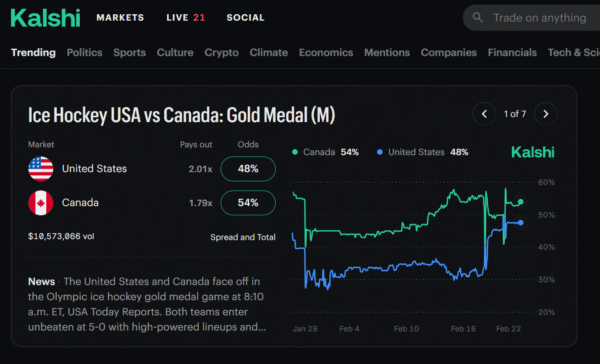
Kalshi and Polymarket had $12 billion traded on their platforms in December 2025 alone, up 400% from the year before.
In short, this is big business, and growing fast.
Isn’t this gambling?
Yes. Don’t let the term “prediction markets” obscure the larger truth. If you’re making a “prediction” on who wins the Super Bowl or the next election, and you put money on this “prediction”, and if your ability to make or lose money is dependent on whether this “prediction” comes to pass? You do the math.
Isn’t online gambling illegal in the U.S.?
I don’t know if you’ve been paying attention, but crime is no longer illegal in the U.S. Look at the actions of the people running things.
Okay, that was kind of a joke. Kind of.
Prediction markets side-step illegality by claiming that they are merely a marketplace, and don’t provide the actual bookmaking. It’s just a space where other people can do predictions, and they aren’t responsible for what people do, right?
Again, this kind of reasoning shouldn’t possibly hold water, but like I said, crime isn’t illegal anymore in the U.S. And it’s not exactly a new strategy to move fast and get rich doing something illegal while you wait for the courts to catch up (hi there, Uber!).
Then again, things have been moving in this direction for a long time. When I was a kid, I remember that you could gamble in Atlantic City and Las Vegas, and that was about it, lottery aside.
But now that sports betting has become much more widespread, it’s obvious that the tide of permissiveness is turning.
What do I think of prediction markets?
It’s gambling made stupidly easy. How do you think I feel about it?
I’m not against gambling, and I don’t think it should be illegal. It’s a vice, which means, like alcohol and credit cards, some people can handle it and some can’t.
I think that any kind of speculative purchase should be thought of as written-off money. What I mean by this is that you shouldn’t ever expect to see any of that money again. If you go into a wager assuming the money is lost, you will never be disappointed (and you will likely never bankrupt yourself either).
When I go to Las Vegas or an equivalent place, I will sometimes allocate a certain amount of money—$40, say—to playing slot machines and the like. I will, by evening’s end, have lost all of this money. But I will have gotten a few hours (hopefully) of entertainment out of the exchange, so it feels appropriate. I never expect to leave with any money, but if I do, it’s bonus.
Gambling is not a way to get wealthy, and it is a tax on people who don’t understand that.
Prediction markets are just gambling, but with the ability to gamble on anything you want.
Sure, some might use these services lightly, but many more people will be ensnared by prediction markets, costing people what little money they had. People will be hurt by these services; I’m not sure many people will be helped.
Here’s a report showing that 70% of Polymarket traders lost money, and only 0.04% of users accounted for over 70% of the platform’s total profits. Someone is winning big, but it’s not you.
What are people predicting?
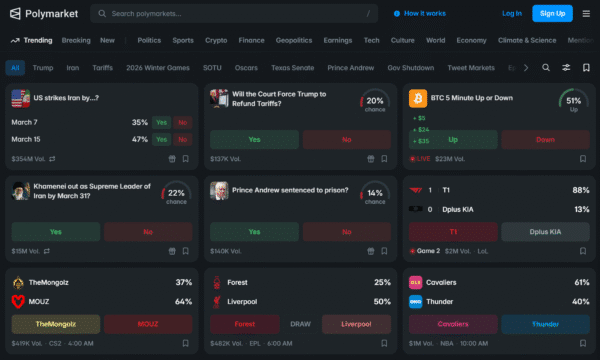
People are betting, er “predicting”, the news, the elections, and sports.
Reading the “trending” section of Polymarket is kind of like a scrambled version of the front page of the newspaper. Just look at this:
That said, some people take the “bet on everything” idea to an extreme. This article from a few months ago lists a few of the craziest bets on Polymarket. Such as:
- Will the return of Christ happen before the release of Grand Theft Auto VI?
- Will the US confirm that aliens exist in 2025?
- Is the Earth flat?
Don’t forget: people are putting real money down of these questions.
Dumb money
In the height of the pandemic, many people were bored and had money and time to kill. Some of those folks gravitated to sites like Robinhood to trade stocks in the hope of making it rich.
Some people did make it rich, but they were lucky. Most people lost lots of money.
Some other people gravitated towards crypto, thinking that if they bought the latest utility token for a decentralized governance project, that the project would eventually “moon” and they’d cash out with big money.
Some people got big money, but they were also lucky. Most people lost their shirts. And that’s even before we factor in disasters like the crash of FTX and other exchanges.
I call this “dumb money” because it was capital allocated based not on fundamentals or research, but due to boredom, naivete, blind hope, or just nihilism.
The people weren’t “dumb”, but the money was.
Why the money has moved to prediction markets
Crypto has been experiencing a rough ride recently. Bitcoin is down about 50% from its high just a few months ago. Ethereum, Solana, and the many other altcoins aren’t doing much better.
And we might just have prediction markets to blame for this.
I believe that the people who were putting their money into crypto (the “retail market”) have moved on to prediction markets. And it’s not hard to see why. Crypto was always about white papers and governance tokens and DAOs, and it generally required you to really dig into a project to really wrap your head around it, to say nothing about understanding wallets and seed phrases and the like. (I’m not talking about memecoins here, which never had anything to wrap your head around.)
Conversely, you don’t need to do any research to bet on the outcome of a sports game, or an election, or any of the other possible bets one can make. It’s easy, and everyone understands it.
Crypto hasn’t been making people rich for a while. People have likely just moved on to betting on something else that’s easier to understand.
Dumb money is still dumb money
It seems deeply ironic to me that in this age of everything becoming more unaffordable, and home prices getting out of reach, that people still bother to throw away their money on gambling.
But then again, maybe it makes sense. For people on the winning side of income inequality, they have more money than they know what to do with, so they can afford to play around.
And for those on the losing side of income inequality, it represents a kind of “Hail Mary” bet. You’re not winning the game of life, so you may as well try to win big. You’ve got nothing to lose.
If true, that hurts my heart. Yes, the system is stacked against most of us, but giving up and throwing money away on bets can’t possibly be a better answer. Sure, it might take a long time for you to pay down your debts or build any level of wealth, but you’ve still got a fighting chance.
But with prediction markets, your “betting on everything” basically means that you’re betting all on one thing. And while the upside might be higher, the chances of everything working out are far lower.
But hey, that’s just my prediction.